Programs
Non-Formal Education Methods in Erasmus+ Projects: Workshops, Games, and Experiential Learning

Introduction
When young people participate in Erasmus+ activities, they’re not sitting in traditional classroom desks learning from textbooks. Instead, they’re engaged in dynamic, interactive learning experiences designed to develop skills that transcend academic knowledge. This is the power of non-formal education—a pedagogical approach that has become central to Erasmus+ program philosophy and mission.
Non-formal education represents a fundamental shift in how we think about learning and youth development. Unlike formal education delivered through structured curricula in schools and universities, non-formal education is learner-centered, action-oriented, and deeply connected to real-world challenges and personal growth. Within Erasmus+ frameworks, it’s the secret ingredient that makes youth exchanges, training courses, and volunteer programs so transformative.
For NGO professionals designing Erasmus+ projects, understanding and effectively implementing non-formal education methods isn’t just beneficial—it’s essential. It directly impacts your project’s quality, your participants’ learning outcomes, and ultimately, your organization’s credibility and success in attracting participants and securing future funding.
What is Non-Formal Education?
Before exploring specific methods, it’s crucial to understand what distinguishes non-formal education from its counterparts. Non-formal education is organized learning that occurs outside formal education systems. It’s intentional and purposeful, yet it differs from formal education in flexibility, accessibility, and approach.
The key characteristics of non-formal education include:
- Learner-Centered Approach. Participants are active agents in their learning journey, not passive recipients of information. The educator acts as a facilitator rather than an authoritative transmitter of knowledge.
- Voluntary Participation. Young people choose to participate because they find the topic meaningful and relevant to their interests or challenges they face.
- Flexible Structures. Sessions aren’t bound by rigid curricula or schedules. Instead, they adapt to participant needs, questions, and emerging interests in real time.
- Experiential Foundation. Learning emerges from direct experience—doing, reflecting, experimenting, and making mistakes in a safe environment rather than only theoretical study.
- Holistic Development. Non-formal education addresses the whole person: cognitive skills (knowledge), behavioral skills (practical competencies), and affective dimensions (attitudes, values, emotional intelligence).
- Informal Recognition. Traditionally, non-formal learning wasn’t officially recognized or certified. However, Erasmus+ changed this through mechanisms like the Youthpass certificate, which validates non-formal learning outcomes and makes them visible and credible to employers and educational institutions.
Why Non-Formal Education Works Better for Youth Development
Research consistently demonstrates that non-formal education produces superior outcomes for youth, particularly regarding soft skills development and behavioral change. The mechanisms behind this effectiveness are worth understanding:
- Memory Retention. Studies show that people retain 10% of what they read, 20% of what they hear, but 90% of what they do and say. By actively participating rather than passively receiving information, young people develop deeper, more durable learning.
- Motivation and Engagement. When learning addresses genuine interests and real-world problems, motivation increases dramatically. Participants invest more effort because they see direct relevance to their lives.
- Emotional Connection. Experiential learning creates emotional engagement that purely cognitive instruction cannot achieve. This emotional dimension makes learning memorable and values-focused.
- Safe Practice Space. Non-formal settings permit young people to try, fail, reflect, and try again without the high-stakes pressure of formal assessments. This psychological safety is crucial for developing confidence and resilience.
- Peer Learning. Through interactive activities, participants learn from each other as much as from facilitators. This peer-to-peer knowledge transfer is particularly powerful for youth working with youth workers.
Core Non-Formal Education Methods in Erasmus+
1. Interactive Workshops
Workshops form the backbone of many Erasmus+ training courses and youth exchanges. Unlike traditional presentations, workshops require active participation around a focused learning objective.
- Structure. A typical workshop combines brief input (10-20 minutes of facilitator-led information), hands-on activities (20-30 minutes), group discussion (15-20 minutes), and reflection (10-15 minutes).
- Why They Work. Workshops allow participants to immediately apply new concepts, identify practical challenges, and develop skills through guided practice. They’re particularly effective for professional development—a youth worker learning to facilitate intercultural dialogue doesn’t just hear about it; they practice facilitation techniques with peers and receive feedback.
- Practical Example. In an Erasmus+ training course on digital skills for youth workers, a workshop might involve participants using AI tools to create educational content, troubleshooting common problems together, and discussing how they’d adapt these tools for their specific youth groups back home.
- Design Tips. Keep workshops interactive by limiting lecture time to 20 minutes maximum. Use the 70-20-10 rule: 70% of learning comes from experience, 20% from social learning, 10% from formal input. Always include a reflection component where participants connect workshop activities to their real-world practice.
2. Experiential Games and Simulations
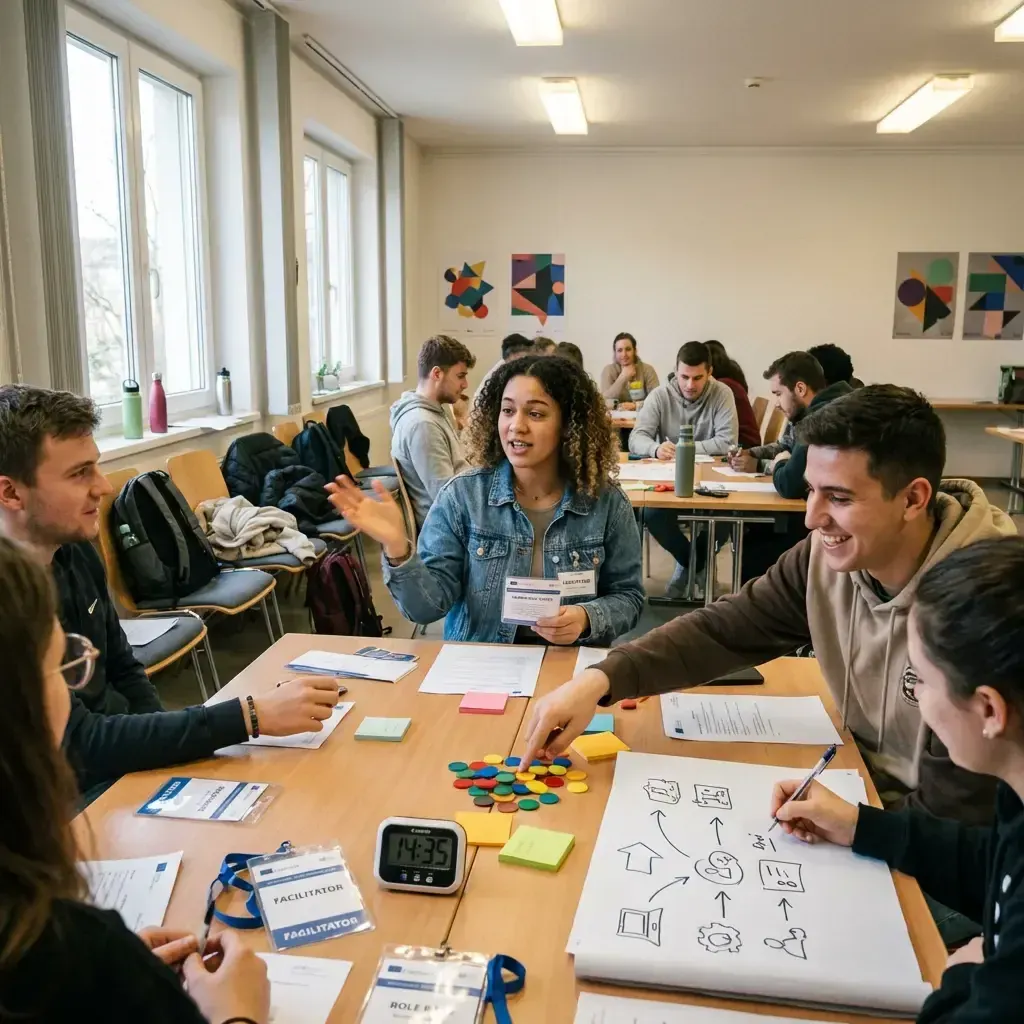
Games are powerful non-formal education tools that simultaneously teach complex content, develop skills, and create enjoyment and camaraderie. In Erasmus+ projects, games serve multiple purposes: energizers, content delivery, skill development, and team-building.
3. Small-Group Discussion and Peer Learning
Some of the most profound learning in Erasmus+ activities happens in small-group conversations. Peer learning—where young people teach and learn from each other—is surprisingly powerful.
4. Project-Based and Challenge-Based Learning
Rather than learning abstract concepts, participants tackle real-world challenges through extended project work. Project-based learning combines multiple effective methods: it’s experiential, it requires collaboration, it produces something meaningful, and it’s inherently motivating because participants see real-world purpose and impact.
5. Role-Plays and Simulations for Skill Development
Role-plays help youth and youth workers practice challenging interpersonal situations in safe spaces before encountering them in reality. They provide low-stakes practice for high-stakes situations and build empathy by requiring participants to step into others’ shoes.
“The best learning happens when you don’t realize you’re learning. That’s the magic of non-formal education.”
6. Outdoor and Adventure-Based Learning
Adventure activities—from low-challenge initiatives (problem-solving tasks) to high-challenge activities (rock climbing, canoeing)—develop resilience, trust, and teamwork while connecting learning to natural settings. Outdoor settings reduce artificiality and power dynamics, and physical challenge creates genuine accomplishment.
7. Storytelling and Narrative-Based Learning
Stories are powerful teaching tools that engage emotion and create meaning. Erasmus+ activities increasingly use personal narratives and testimonial storytelling to make abstract concepts concrete and build connection and empathy.
Facilitator Skills Required for Non-Formal Education
Implementing non-formal methods effectively requires specific facilitator competencies beyond traditional teaching, including creating psychological safety, active listening, managing group dynamics, and cultural competence.
Conclusion
Non-formal education methods transform Erasmus+ projects from standard training into profound personal and professional development experiences. By incorporating workshops, games, peer learning, project work, role-plays, outdoor activities, and storytelling, your organization creates conditions where young people and youth workers don’t just passively receive information—they become active agents of their own learning.
For NGOs in France developing Erasmus+ projects, investing time in understanding and skillfully implementing non-formal education methods isn’t optional—it’s the foundation of project quality that attracts participants, produces measurable impact, and builds your organization’s reputation as a serious, effective Erasmus+ actor across Europe.